
Requirements Analysis for Advanced Materials
Ran a full requirements-engineering cycle for new density-functional-theory features and delivered the inaugural integration between QuantumATK and ARCHER2, the UK national supercomputer — opening HPC-scale modelling to the research group.
Techniques & Methodologies
Elicitation
Mix
Requirements
Catalogue
MoSCoW
BCS req. taxonomy
Functional / Non-functional
Use cases + diagram
Context/scope diagram
BPMN swim-lane
Traceability matrix
Acceptance criteria
Role
Business Analyst
Context / Client
QuantumATK | Archer2
Domain
Computational Modelling / HPC
Duration
6 Months
Business Problem
01. Elicit
Researchers needed DFT capabilities that QuantumATK didn't yet expose, and the group's local compute couldn't handle the scale of the target calculations. No path existed to run these workloads on ARCHER2 — meaning the science was either slow, shrunk to fit, or not attempted. The opportunity: specify the new features and a sanctioned route to national HPC.
Elicitation drew on the full mix — interviews with computational researchers, hands-on observation of existing modelling workflows, document analysis of QuantumATK and ARCHER2 specifications, workshops to reconcile needs, and prototyping to test feasibility of the integration.
Prioritising the backlog
02. Analyse
Raw needs were consolidated into a requirements catalogue, de-duplicated, and prioritised with MoSCoW so delivery could be staged around the integration milestone.
Artefact · MoSCoW prioritisation
Illustrative
MUST
Submit DFT jobs to ARCHER2 from QuantumATK
New exchange-correlation functional support
Reliable results retrieval & parsing
SHOULD
Queue/status monitoring in-app
Restart from checkpoint on failure
Validation against known reference data
COULD
Auto-selection of node count
Batch submission of parameter sweeps
WON'T (YET)
GUI for non-DFT solvers
Multi-site scheduler beyond ARCHER2
Artefact · BCS requirements taxonomy
TYPE
General
Technical
Functional
Non-functional
The non-functional row is the crux of an HPC brief — performance, scalability and portability decide whether the integration is actually usable at scale.
EXAMPLE REQUIREMENT
The solution must comply with ARCHER2 acceptable-use and data-handling policy.
Jobs must be submitted via the ARCHER2 Slurm scheduler over the sanctioned interface.
The user can configure a DFT run with the new functional and submit it to ARCHER2 without leaving QuantumATK.
Throughput, scalability across nodes, portability of inputs, and result reproducibility within defined tolerance.
Illustrative
Model
03. Modelling Use & Flow
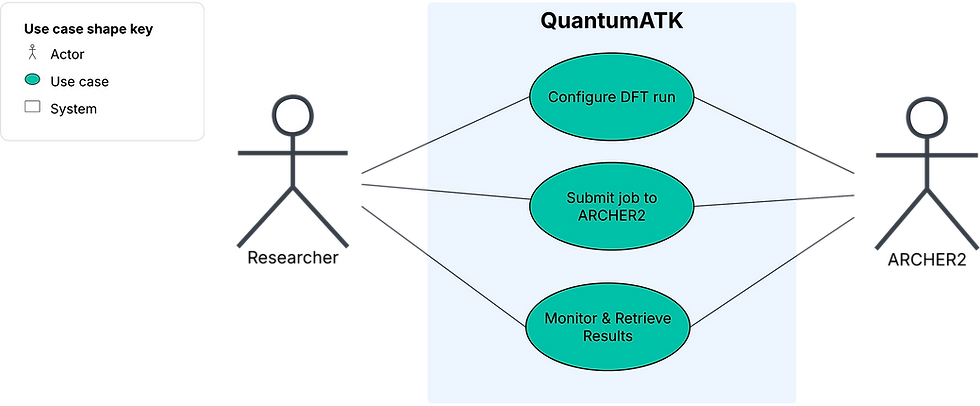
A use-case diagram fixed the scope of who does what with the system; a BPMN swim-lane mapped the end-to-end job lifecycle across the analyst, QuantumATK and the ARCHER2 scheduler.
Artefact · MoSCoW prioritisation
Illustrative
Validation & Acceptance
04. Validate
Acceptance criteria & reference validation
Why · prove the new functional and the integration produce trustworthy science
Each Must requirement carried testable acceptance criteria; results from ARCHER2 runs were validated against known reference data within an agreed tolerance before sign-off.
Context / scope diagram
Why · fix the boundary between QuantumATK and ARCHER2
Clarified exactly what crossed the interface — inputs, jobs, results, status — and what stayed out of scope, preventing boundary creep during build.
Traceability & change
05. Manage
A traceability matrix linked each requirement from source need → catalogue entry → use case → acceptance test, so the impact of any change was visible and the integration milestone could be evidenced as complete.
Reflection
What I’d do differently next time
The lesson was that the non-functional requirements were the real project. The functional asks were straightforward to capture; what made or broke the integration was performance, portability and reproducibility on shared national infrastructure. Next time I'd pull HPC operations into elicitation from day one rather than treating the scheduler as a downstream constraint — their policy and throughput limits shaped the design more than any feature request did.